As a warm-up to how quantum mechanics plays a role in computation, we should consider what quantum mechanics tells us about the physical world. On the other hand, we also want to avoid thinking in too much detail about quantum physics — we don’t reason about every-day computer programs by talking about the properties of metals and transistors. So today we will try to consider how much of quantum mechanics we need to know, to go forward.
I’m not going to introduce much in the way of mathematics — for this first approach, I’m going to try to describe things qualitatively, so that we can better approach the mathematics in future posts.
(Of course, I’m not the first to try to solve the problem of describing quantum mechanics, nor the first to do so to try to introduce quantum computation. My hope is to present a particular approach to describing quantum mechanics to make the more mathematical comping up approachable.)
Two things “everyone” knows about quantum mechanics
Good descriptions of quantum mechanics and quantum computation are rare — you have to spend time even finding a decent exposition before you can have a chance at learning much about them. But there are at least two closely related concepts from quantum mechanics which have caught the popular imagination, which are reasonably accurate descriptions. These are the Heisenberg uncertainty principle, and wave-particle duality. I will describe these two ideas in qualitative terms below, with only a little bit of mathematics.
The Uncertainty Principle
There is actually more than one uncertainty principle. The famous one is Heisenberg’s uncertainty principle, which says that it is not possible to precisely know both the position of an object, and its momentum (which is its mass times its speed, together with its direction of travel), at once. In fact, there is a lower bound to how well both can be known: if Δx is the amount of uncertainty in the position, and Δp is the amount of uncertainty in the momentum, then ΔxΔp 
There are other less well-known uncertainty principles. One of these, which is still fairly commonly known among people interested in quantum mechanics, is one involving time and energy — specifically, between the length of time Δt that a particle is in a particular state, and the uncertainty about the energy ΔE of the particle. These satisfy a similar inequality, ΔEΔt
What isn’t necessarily grasped by everyone who “knows” about the uncertainty principle is that — assuming of course that quantum mechanics is correct — this isn’t just a technological limitation. It isn’t even “just” a limitation to what we can find out about the world. There is a sense in which things in the world do not have definite positions, or speeds, or energies.
At this point you may well ask: “How can that possibly be?”. I cannot provide a good answer to you yet — but I don’t ask you to take it on faith either, because (a) you will eventually be able to see how this is the case, and (b) we don’t yet need to rely on it to accomplish anything. For now, I’m just describing the Uncertainty Principle as a popular concept from quantum mechanics, to acknowledge it as a concept but without much further comment. However, one way of approaching an understanding of the uncertainty principles is by the other basic concept I will try to describe, which is wave-particle duality.
Wave-particle duality
The other popular idea of quantum mechanics is that in physics, there is a “wave-particle duality”. This idea is that basic units of matter (such as electrons and protons) and energy (such as photons) behave sometimes like waves, and sometimes like particles. Furthermore, it is sometimes said that the units of matter and energy behave like particle when we try to find “particle-like properties” or when we “interact with them in particle-like ways“, and similarly that they act like waves when we try to find “wave-like properties” or when we “interact with them in wave-like ways“.
Whatever can this mean? Does this mean that if electrons and photons act sometimes like waves and sometimes like particles, that they always act like one or the other? Does that mean that we are always interacting with them, in either wave-like or particle-like ways? How do we not notice that we are always interacting with everything in the universe at once, affecting whether they are acting like waves or particles?
To explain this, it might be best to provide some context, to describe how we came to believe such strange things in the first place.
A short history of quantum mechanics
In fact, “wave-particle duality” is a simplification of the modern way of understanding quantum mechanics — but it is also the original way of understanding quantum mechanics. Remembering how this idea came about in the first place will help to motivate the better understanding that we are leading up to.
Light waves and interference
We often talk about light as a wave. Specifically, like radio waves, the microwave radiation in microwave ovens, and x-rays, light is an electromagnetic wave — a small vibration in the strengths of electric and magnetic fields. We won’t go into the physics of this, but to start with it will be useful to think of light as a wave.
You may have heard of the “double slit experiment”, of which the first example is Young’s interference experiment, illustrated on the right (image source).  The idea is to have a bright light source on the left-hand side, and then let only a very thin band of light through a narrow gap (point a). That light then spreads outward, to another barrier which only lets two thin bands of light through (points b and c). If the gaps are narrow enough, what you see on the wall on the right (e.g. at point d) are not two spots where the light comes through b and c, but an interference pattern of light and dark.
What does this have to do with waves, and why do we call these “interference patterns”? If you’ve veer played with a rope, or if you have ever seen a guitar string under a strobe lamp or on some digital cameras, you may have seen so-called standing waves. These happen when a string, or anything else, vibrates for a period of time (which might be shorter or longer). While the string (or rope) vibrates, the energy of the vibration causes some parts of the string to wiggle back and forth, while others barely move at all.
These waves are called “standing” waves because they don’t look as though they are moving back or forth along the string. However, it is possible to understand these standing waves in terms of waves of energy moving back and forth along the string (see the Wikipedia article for details). The places where the string or rope vibrates a lot, is where the crests and the troughs of the forward-travelling waves and the backward-travelling waves add together to make a big crest or trough (called “constructive interference”); where the string or oops doesn’t vibrate are the places where the crests of the forward-travelling waves meet the troughs of the backward-travelling waves, cancelling each other (called “destructive interference”).
The same adding or cancelling happens with Young’s interference experiment, and is what convinced physicists in the 19th century that light acted like a wave. The light is an oscillation, and light waves from two different directions could add or cancel under the right conditions. Where the light meets the wall, we see a cross-section of the more complicated waves, and see a standing wave pattern — the bright spots are where the light waves are strongest, and the dark spots are where the light waves destructively interfere.
Where do particles come in?
If light acts like a wave, where does the wave-particle duality come in?
The answer is that light acts convincingly like a wave, at the macroscopic scale. But there are occasions in which it seems to act like a particle: specifically, light being formed of particles is the best way to understand the light given off by hot objects, and the way that light can be absorbed by metals and cause them to emit electrons. At first, this was deeply confusing to physicists — and in some ways, it still is, though it is now possible to reason more consistently about light despite this strange behaviour.
Some time after it was realised that light behaved in some ways like particles and in some ways like waves, things such as electrons sometimes also behaved in strange ways. In the model of the atom that became popular shortly after it was accepted that light sometimes acted like a particle, an electron moving around an atomic nucleus could only have certain energy levels — not unlike the harmonic vibrations of a guitar string. This was eventually explained by considering the possibility that, like a guitar string, the electron actually could be understood as being like a standing wave, except that the electron is a wave in three dimensions around the nucleus of an atom instead of being a wave in one direction along a string.
 (Unfortunately, it is not easy to show what a 3D standing wave is like, but 2D standing waves are a bit easier to demonstrate: see for example the animation on the right (image source). The way that sand gathers at some places on a vibrating plate and bounces in others also forms a sort of negative-image picture of a standing wave in 2D.)
The main breakthrough, then, was this: that electrons could be described by ‘vibrations’ or ‘oscillations’ in three dimensions, at least for the purposes of understanding how they behaved in atoms, and that this could be used to describe the way atoms behaved. And this was no small thing (even though the subject was atomic physics): among other things, it explains why atoms exist in the first place, instead of the electrons spiralling into the positively charged protons of the nucleus like a wayward comet crashing into the sun.
The beginning of quantum mechanics
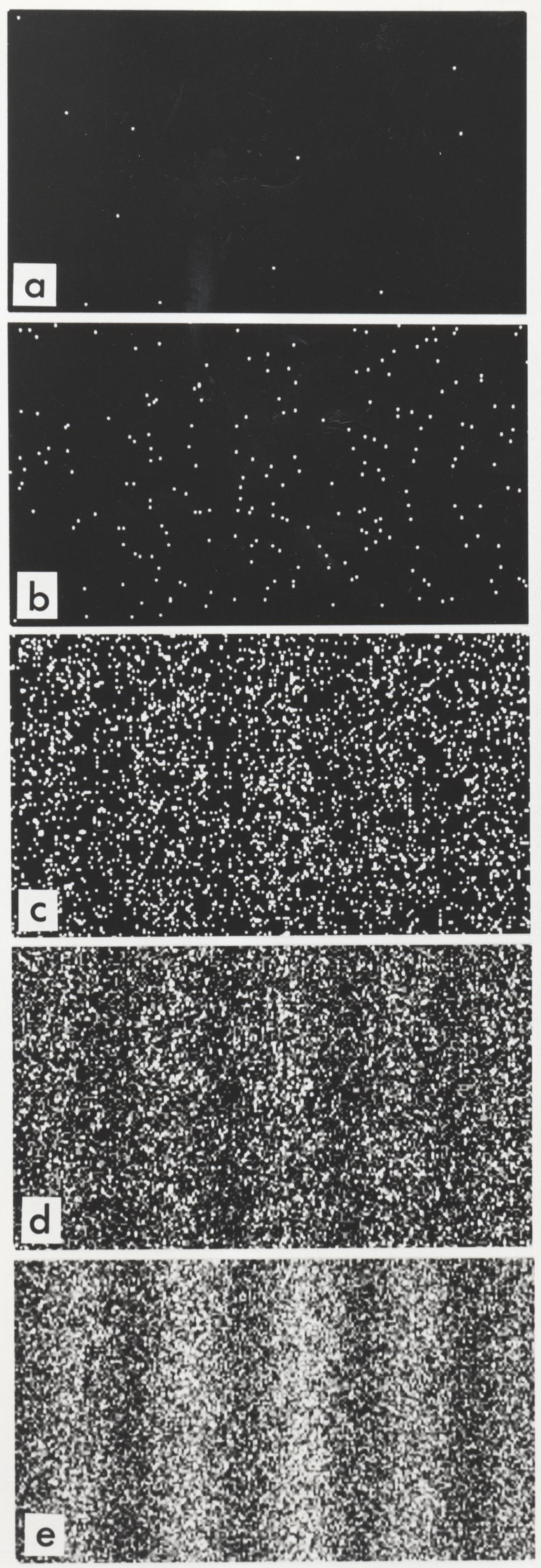 Shortly after this idea was discovered, quantum mechanics began. It was based precisely on the concept that all matter and energy acted as waves — most of the time. Specifically, in the same way that classical physics is essentially defined by objects moving according to Newton’s ‘laws’ of motion, quantum mechanics is essentially defined by ‘particles’ moving according to the Schrödinger wave equation, or a variation on it which takes special or general relativity into account. And it is important to treat ‘particles’ as though they can act like waves. Just as Young’s interference experiment established that light acts like a wave, one can do double-slit experiments using individual electrons, which pass through one slit or the other — or, one might say, both slits at once ‐ and measure where they arrive on the screen, to produce exactly the sort of interference pattern that one obtains for light. The figure on the right (image source) shows exactly this, for electrons in a two-slit experiment: it shows a screen which shows spots of light where electrons hit it, which was put into a double-slit experiment where electrons were made to pass through the slits one at a time. Each dot represents a location where a single electron met the screen: and despite each electron passing through the slits on its own, together they make an interference pattern. It shows that there are places where electrons are much less likely to show up — in a way that can’t be easily explained unless each electron on its own is acting like a wave.
This is what we mean when we say that things act “both like particles and like waves”: we can isolate individual particles to detect single electrons, or photons, but the places where we detect them reveal that they were acting like waves before they were measured.
Putting a fine point on wave-particle duality
There is something a little odd about this description. We see the interference pattern in the image above, and because the electrons appear one at a time, we might be persuaded to think that it is the individual electrons which are acting like waves. Because the electrons appear in places where the waves vibrations add rather than cancel one another, it seems that the location of the electron has something to do with the vibration of the wave. But why should that be, and what is that relationship? And if the wave is spread out — as it must be, if each electron acts the same as the others while still producing the interference pattern — why does it appear at one place and not another?
This is related to why I suggest that one could say that electrons pass through ‘both’ slits at once. The electron acts as a wave, spreading out from its original source and rippling through the two-slit experiment until it is detected. And if the position of the electron is related to where the waves are most intense, it there is no reason why we should think of it as passing through one slit or another, given that the wave passes through both.
This may seem very confusing. You could rightly ask whether the particle isn’t actually somewhere in particular before it is detected. If it is, then by tracing its path, it must surely have passed through one slit or another.
One way in which one could respond to this criticism is to invoke the Heisenberg Uncertainty Principle: no, in fact, the particle doesn’t have a precise position before it is detected. But unfortunately such a response doesn’t actually explain anything — it’s just a more authoritative repetition of the same fact that the particle doesn’t have a definite position, only using the name of a now-deceased German physicist to make it sound more definitive.
In truth, this is one of the two central ‘mysteries’ of quantum mechanics. (We will touch on the other ‘mystery’ of quantum mechanics, entanglement, another day.) This so-called ‘mystery’ is less mysterious than it was when (mostly German) physicists became famous for investigating them in the 1920s–30s establishing the now well-verified mathematical formulae. But the basic message is this: the apparent definiteness of things which we see in our everyday lives is not shared by small pieces of matter or parcels of energy.
This doesn’t mean that nothing is ‘real’, or that everything is real, or that reality is what you make it — we have equations which describes how those particles act. And it turns out that in simple situations, they act like waves in a very orderly fashion, right up until you try to detect them. Why the detection should matter, and whether anything else could keep quantum bits of matter from acting like waves, is something I’ll touch on in a future post.
An apology
I’ve just used the word ‘mystery’ a few times. I would like to apologise for this, because the purpose of this blog really is to explain, and not to wax poetical or to overawe. But I am not making a mistake in describing it that way — I use the word ‘mystery’ because it is important than I make something clear: that there does not exist any simple and well-accepted description of how quantum mechanics works. There are only well-accepted complicated descriptions.
The good news is that since the development of quantum information theory, there are now descriptions of quantum mechanics that can in principle be approached after only three or four university-level courses in mathematics, rather than two-thirds of a physics degree programme. One of the purposes of this blog is to set out how to approach quantum mechanics in this way. But it is very likely that it will never be possible to adequately describe, let alone explain, quantum mechanics without university-level mathematics as well as an ability to suspend one’s disbelief. Understanding quantum mechanics, or even its simplified form in quantum information theory, is a monumental task worthy of being taken up in a monastery — slowly, and with great care.
Despite this, I will in the next few posts attempt to describe quantum mechanics as well as I can without mathematics, because it is important to try.
 The Quantum Monastery

